
Lesson 25 · Expert · 15 min
AI Usage Policy, Security, and Sovereignty: QDNA Governance
AI governance and sovereignty: three-tier data classification, EU AI Act compliance, and trade-offs between public cloud and sovereign QDNA servers.
- Goal
- You will design your enterprise AI governance framework, comply with the EU AI Act, and evaluate trade-offs between public cloud and sovereign on-premise servers.
- Skills
- Frame

Your first attempt, unaided
Draft an enterprise generative AI usage charter comprising 5 golden rules and explicitly detailing prohibited data categories.
Sustainable enterprise mastery of ChatGPT demands thoughtful governance balancing employee productivity with absolute data sovereignty. Navigating the EU AI Act and GDPR, organizations deploy the three-tier classification policy to govern data flows. While ChatGPT Team or Enterprise supports daily operational workflows, critical strategic intellectual property warrants deployment on sovereign on-premise AI servers engineered by QDNA.
1The EU AI Act framework and the public cloud versus on-premise trade-off
The EU AI Act framework and the public cloud versus on-premise trade-off establish the strategic frontier for enterprise technology leadership. European regulation does not seek to stifle innovation; rather, it obligates organizations to ensure staff AI literacy while forbidding opaque, high-risk automated decision systems.
In this architecture, enterprises route workloads based on asset sensitivity. Enterprise cloud workspaces (ChatGPT Team/Enterprise) provide agility for market research and administrative synthesis, whereas on-premise GPU inference clusters provide physical data sovereignty for confidential red-tier intellectual property.
Infrastructure Tier Hosting Location & Legal Bounds Data Privacy Contract Recommended Workplace Scope Consumer Free ChatGPT Public US cloud clusters Training enabled by default Personal experimentation (zero corporate records) ChatGPT Team / Enterprise Secured OpenAI cloud with DPA Contractual zero-training Operational business workflows (green & orange tiers) Sovereign QDNA Server On-premise air-gapped datacenter Physical local custody Strategic intellectual property (red tier assets) 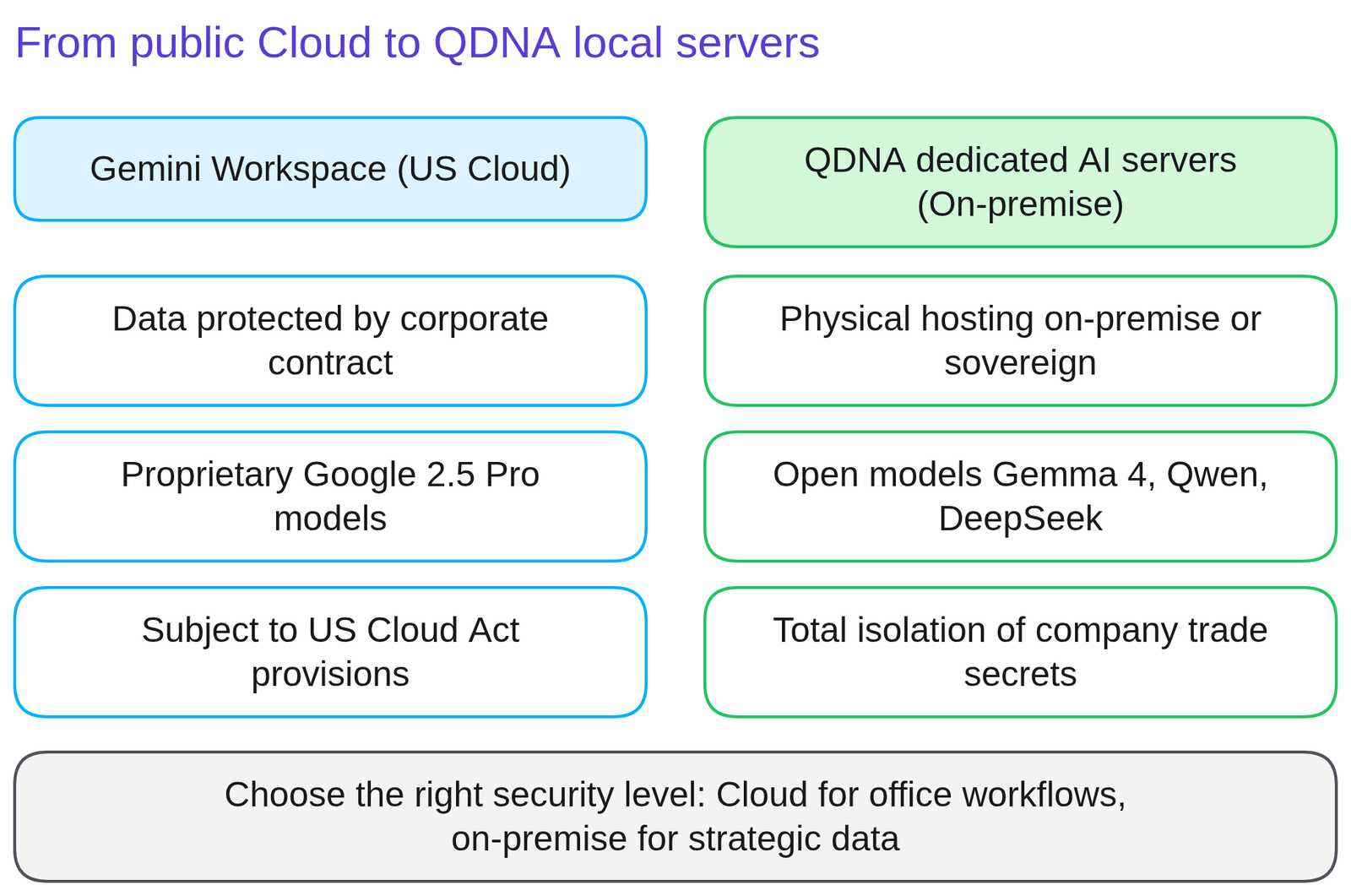
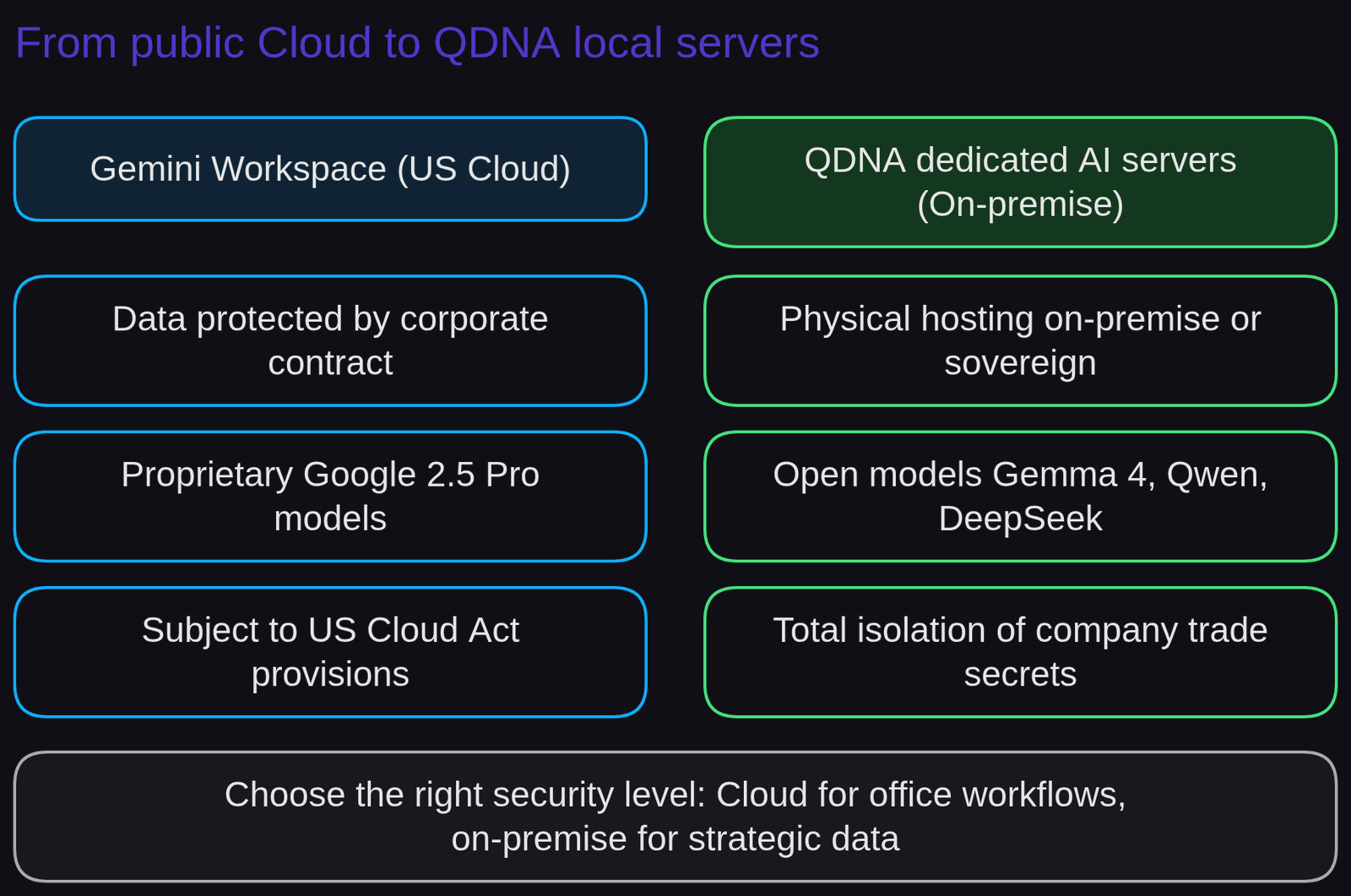
Diagram of AI governance and sovereigntyDiagram generated by AI and reviewed 2Constructing an architectural decision matrix between cloud and local servers
Constructing an architectural decision matrix between cloud and local servers enables leadership to establish intuitive data routing policies without paralyzing line-of-business initiatives.
A biotechnology enterprise deploys AI capabilities across 200 researchers and operations staff.
Operational Data Routing Matrix.
- Flow 1: Marketing drafts, translation, public literature search, vendor correspondence.
  -> Routing: ChatGPT Team with centralized administrative governance.
  -> Rationale: Non-proprietary public-domain text, instant operational productivity gains.

- Flow 2: Patented molecular formulations, genomic sequencing, clinical trial records.
  -> Routing: Dedicated on-premise QDNA AI servers within private enterprise datacenters.
  -> Rationale: Industrial espionage risk, statutory HIPAA/GDPR health data compliance, physical data custody.
What changes. Rather than enforcing broad bans, the enterprise directs every data flow to the architecture providing the optimal balance of speed, cost, and legal defensibility.
3Draft an actionable corporate AI usage policy for your workplace
Draft an actionable corporate AI usage policy for your workplace to conclude this curriculum by establishing permanent governance standards for your organization.
Author an internal corporate AI usage charter across 5 foundational principles:
- Human accountability: the human operator remains solely responsible for published outputs.
- Data sensitivity tiers: clear taxonomy of permitted (green) versus prohibited (red) content.
- Transparent disclosure: mandatory flagging of generative assistance in corporate documentation.
- Mandatory verification: strict prohibition against circulating metrics without verified primary references.
- Incident response: explicit reporting protocols for accidental sensitive data leakage.
Self-evaluation rubric: (a) all 5 principles are written with clear, empowering language; (b) the three-tier data doctrine is codified; (c) the policy is ready for formal executive submission.
4Enforcing blanket bans or adopting unmonitored permissive laissez-faire
Enforcing blanket bans or adopting unmonitored permissive laissez-faire represent twin failure modes that compromise organizational security and value creation.
Blanket bans ('Generative AI is forbidden on corporate devices') immediately foster massive Shadow IT: employees bypass filters on personal smartphones using unmanaged consumer accounts. Conversely, unregulated usage results in IP leaks or defamation disputes driven by unedited hallucinations.
Correction: formalize usage through enterprise accounts (ChatGPT Team or Enterprise) and govern practices with transparent charters and continuous team enablement.
Rule to remember: you do not secure generative AI by banning it; you secure it by training the professionals who operate it.
5Quiz
Three questions, instant feedback. Each option comes with an explanation.
6Proof of mastery
Author a comprehensive enterprise generative AI usage policy covering three data tiers and sovereign architecture decision gates.

Criteria
What you wrote at the start of the lesson


Going further
Review glossary definitions for eu ai act, ai sovereignty, and shadow it. Congratulations: you have completed all 25 lessons of the OpenAI ChatGPT curriculum! You now possess full operational and governance mastery to pilot generative AI with precision and security. Explore dedicated on-premise server architectures at QDNA AI Servers and review complementary tracks on Learn AI.
Frequently asked questions
What obligations does the EU AI Act place on enterprise deployers?
The AI Act mandates AI literacy training for employees, transparent notification when interacting with AI systems, and prohibitions on unacceptable risk use cases.
When should organizations migrate from cloud ChatGPT to on-premise sovereign servers?
Whenever handling highly confidential assets (trade secrets, protected health records, classified defense contracts, proprietary software repositories) subject to strict sovereign jurisdiction.
What are the core benefits of on-premise sovereign QDNA infrastructure?
Dedicated local servers ensure enterprise records never leave internal network perimeters, eliminate per-token cloud billing at high volumes, and deliver predictable low latency.