
Lesson 3 · Beginner · 15 min
Writing a good Gemini prompt: the four PTCF pillars
Master Google's official PTCF framework: Persona, Task, Context, and Format. Deliver immediately actionable answers without endless rewrites.
- Goal
- You will structure workplace prompts using Google's PTCF method to eliminate vague and unhelpful AI drafts.
- Skills
- Frame

Your first attempt, unaided
Ask Gemini to write an email postponing a team meeting. Note what details are missing before you could actually send it.
A high-performing Gemini prompt coordinates four core pillars: Persona, Task, Context, and Format (the PTCF framework). Explicitly stating who speaks, what action is needed, what business constraints apply, and what output structure is required eliminates ambiguity. Always quantify desired word counts and specify structural layouts to produce immediate workplace deliverables without tedious revisions.
1The PTCF architecture: Google's official standard
The four PTCF pillars represent Google official prompt engineering framework for professional workflows: Persona, Task, Context, and Format together guarantee that outputs become instantly usable without manual post-processing.
A generative model cannot deduce implicit expectations or target audience nuances. Omission of length or structure causes Gemini to default to verbose conversational prose. By aligning the role (Persona), the core action verb (Task), operational boundaries (context), and output specifications (format), you remove guesswork on the first turn.
PTCF Pillar Operational role Key guiding question Practical example Persona (Role) Sets posture, tone, and vocabulary Who is communicating and with what expertise? « Act as an executive corporate financial auditor » Task (Action) Establishes the exact deliverable What precise verb defines the required work? « Write an executive briefing on budget variances » Context (Frame) Clarifies audience and situational constraints For whom, under what circumstances, and why? « For an audit committee reviewing new logistics risks » Format (Structure) Enforces length and visual layout How should the final content be structured? « A 3-column table with a 120-word total limit » 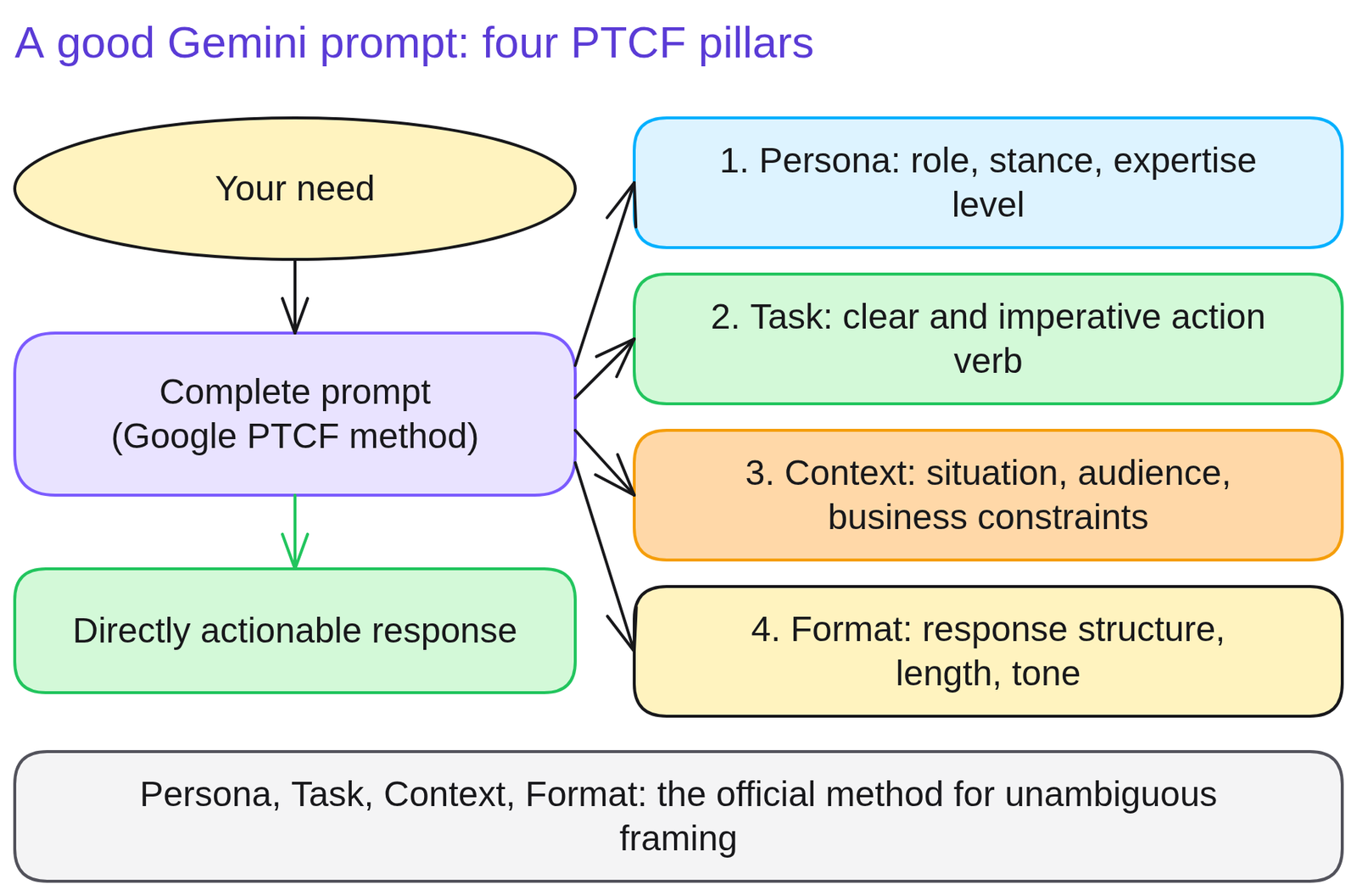
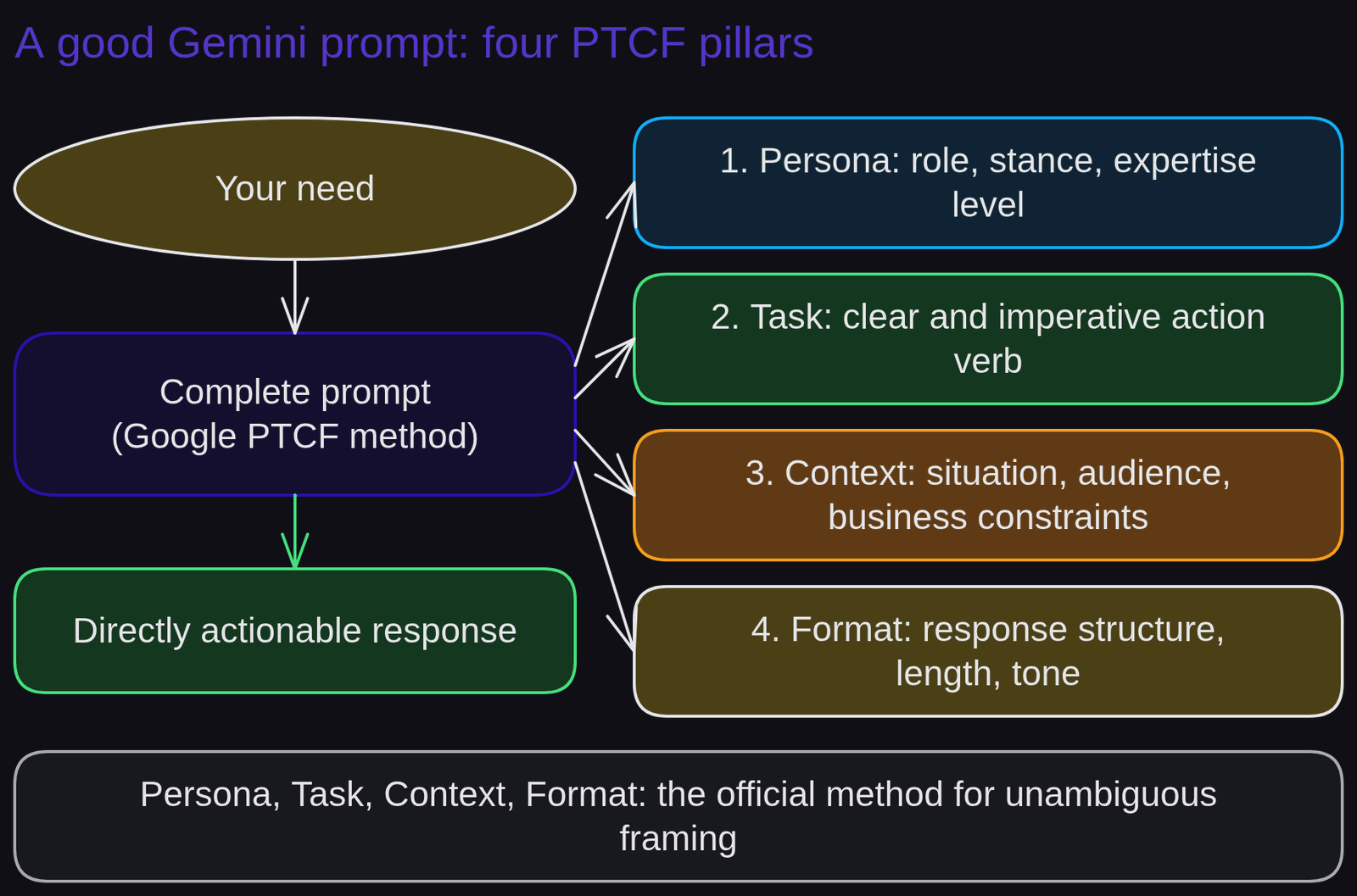
Diagram 'A good Gemini promptDiagram generated by AI and reviewed 2Transforming a vague request into surgical guidance
Transforming a vague request into surgical guidance illustrates how the four PTCF pillars convert generic conversational answers into structured, executive-ready enterprise communications.
A program manager needs to notify operations teams about a two-week delay in software deployment.
Weak prompt.
Write an email saying that the ERP deployment is delayed.Gemini outputs an alarming, open-ended message that fails to address operational impacts or explain recovery timelines.
Strong prompt.
Act as an empathetic yet authoritative IT delivery director (Persona). Draft a 100-word internal announcement (Task) for 40 regional warehouse leads (Context). Explain that the ERP rollout shifts from October 15 to October 29 to complete inventory stress tests, with no disruption to customer shipments. Conclude with 3 dated bullet points outlining support desk shifts (Format).The difference. The PTCF prompt incorporates all critical business facts and sets strict formatting bounds, yielding a communication ready for immediate transmission.
3Draft an internal announcement with all four pillars
Write a complete prompt with the PTCF method to master decomposing workplace requirements into four explicit components before querying Google Gemini.
Select an upcoming work assignment (client renewal reminder, safety advisory, meeting briefing). Draft a prompt incorporating Persona, Task, Context, and Format.
Run this structured prompt:
'[Persona: role] + [Task: core action and deliverable] + [Context: business setting and audience] + [Format: layout and word ceiling]'
Self-evaluation rubric: (a) the persona defines domain expertise ; (b) the task opens with an unambiguous action verb ; (c) the context eliminates unstated assumptions ; (d) the format enforces a numerical limit and clear visual structure.
4Assigning a superficial persona without format boundaries
Piling up adjectives instead of specifying exact requirements generates verbose, theatrical text because generative language models interpret qualitative descriptions as an encouragement to elaborate.
Writing 'Make it very crisp, highly compelling, deeply professional, and exceptionally concise' gives the model zero measurable bounds. Conversely, requesting 'Write exactly 80 words structured across 4 bullet points of 20 words starting with an imperative verb' enforces mathematical precision.
Fix: replace subjective evaluative adjectives with numerical length limits and concrete layout templates.
Rule to remember: quantified constraints on length and visual structure consistently outperform subjective adjectives.
5Quiz
Three questions, instant feedback. Each option comes with an explanation.
6Proof of mastery
Submit a full prompt explicitly applying the four PTCF pillars (Persona, Task, Context, Format) alongside the direct output generated in Gemini.

Criteria
What you wrote at the start of the lesson


Going further
Review the glossary definitions for output format, role, and constraint. The next lesson, First Gemini conversation: summarize, rewrite, translate, applies PTCF across daily document workflows. For role-specific prompt templates, explore the Project Manager prompt library and Executive Assistant prompt library.
Frequently asked questions
What does the PTCF acronym stand for?
PTCF stands for Google's official prompt pillars: Persona (role), Task (action to execute), Context (background and audience), and Format (output structure).
Is a persona required for every prompt?
No. The Task is the only strictly mandatory element. However, Persona becomes essential whenever professional tone, perspective, or specialized seniority matters.
Why specify exact numerical length?
Vague guidelines like 'keep it short' leave length to chance. Specifying a precise number ('under 90 words' or 'in 5 bullets') ensures exact calibration.