
Lesson 25 · Expert · 15 min
Usage policy and sovereignty: enterprise AI rules and clouds
Establish enterprise AI usage policies. Reconcile public cloud, enterprise Gemini tenants, and on-premise sovereign hardware architecture.
- Goal
- You will formulate an enterprise AI usage policy and architect operational boundaries between public cloud and sovereign infrastructure.
- Skills
- Frame

Your first attempt, unaided
Draft a three-tier traffic light policy (green, amber, red) classifying data types authorized for ingestion across enterprise AI platforms.
An enterprise AI usage policy does not mean imposing blanket bans: it sets explicit rules of engagement to protect organizational assets. By structuring governance across three distinct concentric circles (public data, internal records, confidential secrets), you eliminate data leakage risks while empowering daily team innovation.
1Three-tier governance: balancing competitive speed and information security
Three-tier governance balances competitive speed and information security across an enterprise. Establishing explicit operational boundaries prevents bureaucratic gridlock while safeguarding trade secrets and intellectual property.
A modern AI usage charter categorizes corporate records into three concentric security rings. The Green Tier covers public information and desk research: employees use Gemini freely without administrative overhead. The Amber Tier covers internal operational documents (memos, project logs, meeting notes): processing requires enterprise-protected licenses (Enterprise Data Protection). The Red Tier encompasses core trade secrets, patient health records, and acute legal disputes, where uploading text into external AI platforms remains strictly banned.
Governance tier Covered data classes Approved environment Compliance obligation Green Tier (Open) Public press, published statutes, research Consumer or Workspace tiers Zero sharing restrictions Amber Tier (Controlled) Internal memos, team files, operational logs Corporate Google Workspace required Contractual zero-training protection Red Tier (Restricted) Trade secrets, employee health, litigation On-premises sovereign infrastructure Complete ban on external cloud tools 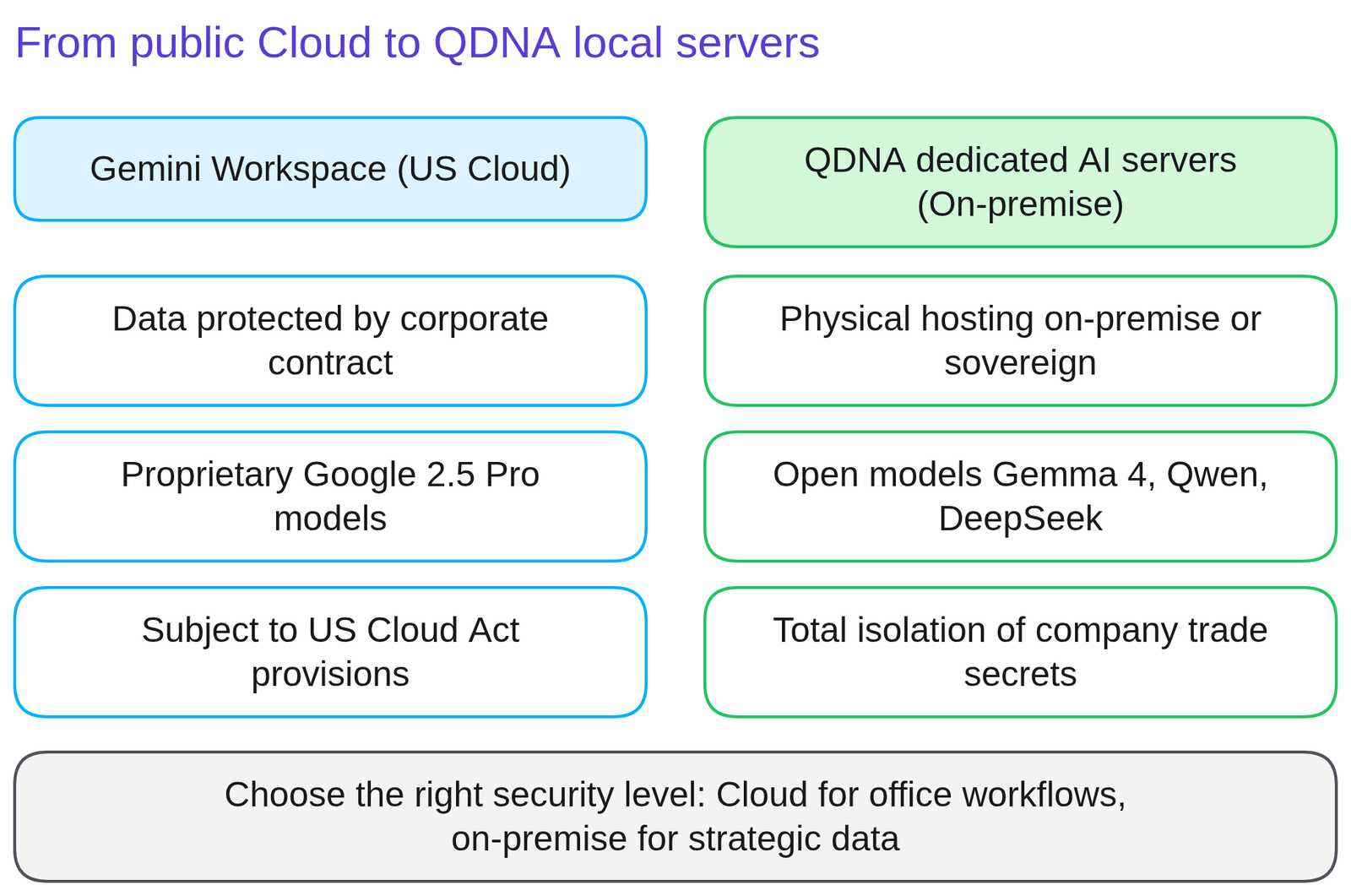
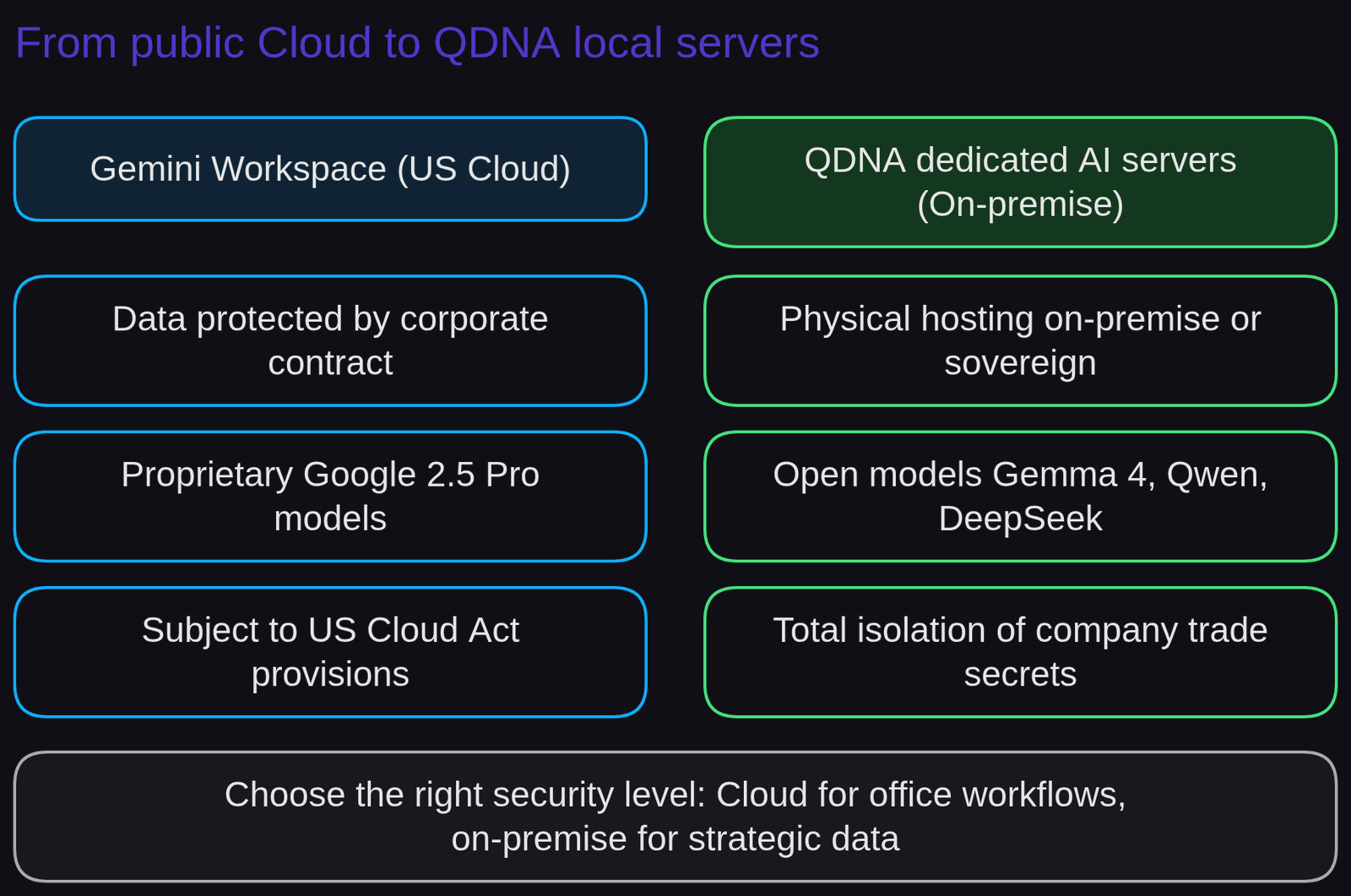
Diagram 'AI Governance and QDNA Sovereignty'Diagram generated by AI and reviewed 2A data classification matrix for mid-market and enterprise organizations
A data classification matrix for mid-market and enterprise organizations demonstrates how defining operational security boundaries removes employee hesitation before prompting on workplace tasks.
A corporate IT director wants to establish clear guidelines for 500 regional employees.
Weak policy.
The use of generative artificial intelligence platforms is strictly forbidden across all corporate devices without prior written approval from the executive committee.Employees circumvent the blanket ban by using personal smartphones to process urgent files, generating uncontrolled and untraceable Shadow AI.
Strong policy.
Enterprise AI Data Matrix: 1) Public Information (Green Tier): unrestricted usage across all workstations ; 2) Internal Business Files (Amber Tier): permitted exclusively under corporate Google Workspace accounts with mandatory employee name sanitization ; 3) Trade Secrets and Medical Records (Red Tier): strictly prohibited. Red Tier violations trigger formal disciplinary proceedings.The difference. Rules are practical and transparent: employees adopt protected corporate accounts enthusiastically, eliminating dangerous Shadow AI.
3Draft your organization's AI usage charter across 5 core rules
Draft your organization AI usage charter across 5 core rules to learn how to establish a collaborative security framework that protects company assets without stifling operational productivity.
Consider the daily workflows of your organization. Draft 5 fundamental rules covering approved tools, personal data anonymization, mandatory human review, transparency, and incident reporting.
Run this governance prompt:
'Act as Chief Compliance Officer and Corporate Data Protection Officer. Draft an enterprise generative AI usage charter comprising 5 operational articles of 25 words each: 1) Approved Tools ; 2) Personal Data Protection ; 3) Mandatory Human Review ; 4) Team Transparency ; 5) Incident Disclosure. 130 words.'
Self-evaluation rubric: (a) all five articles address critical corporate liabilities ; (b) the distinction between consumer and enterprise licenses is explicit ; (c) human accountability for final deliverables is formalized.
4Imposing blanket bans that drive employees toward unmonitored Shadow AI
Imposing blanket bans that drive employees toward unmonitored Shadow AI represents the single most dangerous strategic error in corporate enterprise governance.
Banning technology without providing a secure corporate alternative does not eliminate usage: it drives it underground. Staff continue pasting sensitive data into unvetted consumer tools on personal laptops to meet tight deadlines, exposing the company to unmonitored data leaks.
Fix: provision secured enterprise accounts (Google Workspace with Enterprise Data Protection) and train teams on data classification boundaries.
Rule to remember: a sound AI policy guides and secures employee usage; it never pretends it can ban the tool.
5Quiz
Three questions, instant feedback. Each option comes with an explanation.
6Proof of mastery
Draft the enterprise AI usage policy for your organization: detail the 3-tier data classification model and 5 mandatory ethical rules.

Criteria
What you wrote at the start of the lesson


Going further
Examine glossary entries for governance, enterprise data protection, and shadow IT. Congratulations: you have completed all 25 lessons of the Google Gemini cursus. To validate your mastery, submit your proofs on your Account page and claim your Verifiable Badges.
Frequently asked questions
Why is a blanket prohibition on AI hazardous for organizations?
Because bans do not stop usage; they drive it underground (Shadow AI). Employees paste corporate data into personal accounts on personal devices, multiplying data leak exposure.
What defines the Cloud vs. Sovereign On-Premise tradeoff?
Public Cloud (Gemini) delivers massive compute and 2-million-token contexts. Sovereign on-premise deployments (dedicated local AI hardware like QDNA systems) guarantee zero-exfiltration isolation for trade secrets and health records.
Who should author the enterprise AI policy?
A cross-functional task force unifying the CIO, Chief Information Security Officer (CISO), Data Protection Officer (DPO), and operational domain champions.